Inner Voice
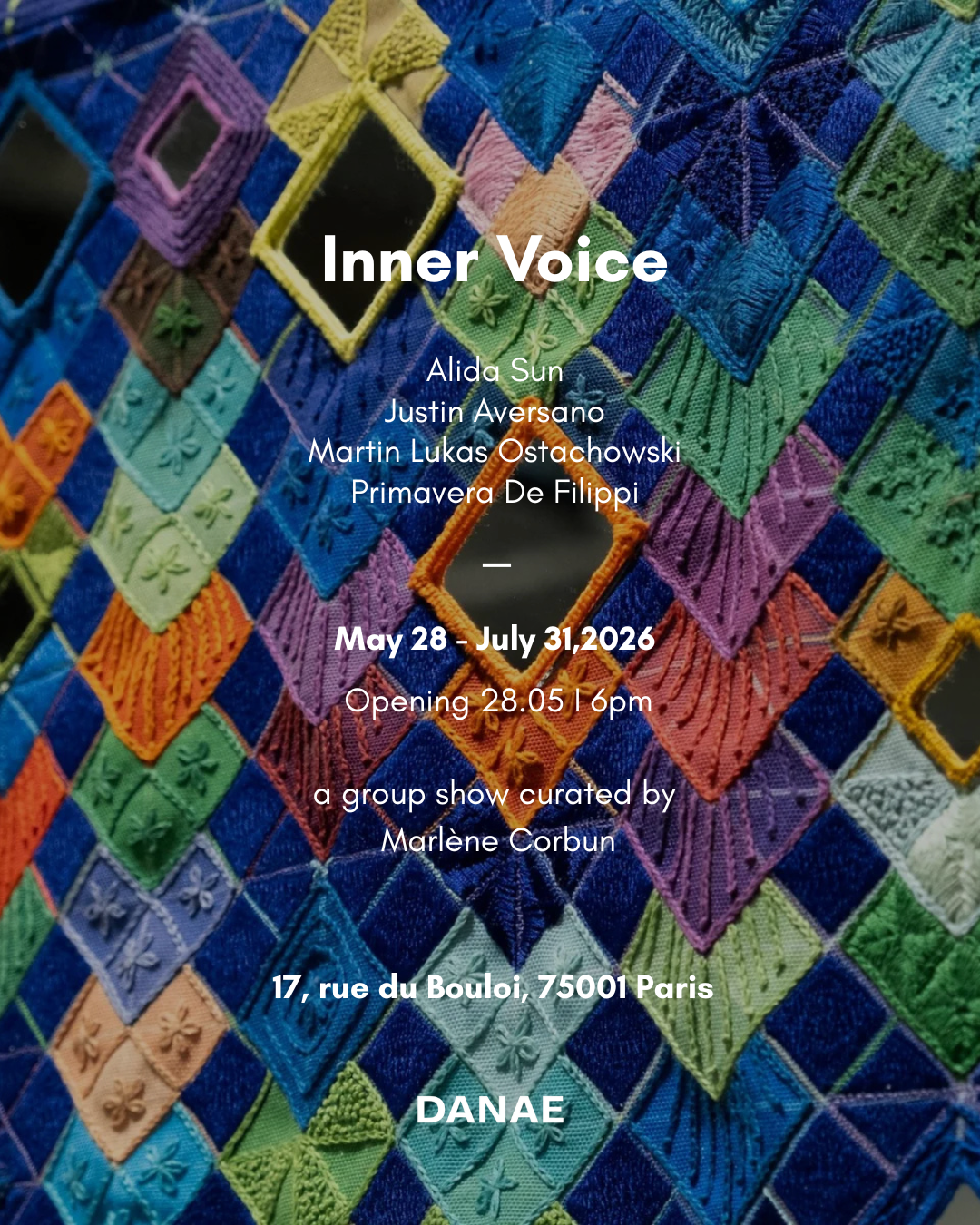
Group show with Alida Sun, Justin Aversano, Martin Lukas Ostachowski, Primavera de Filippi
"The inner need is built up of three mystical elements: (1) Every artist, as a creator, has something in him which calls for expression. (2) Every artist, as child of his age, is impelled to express the spirit of his age. (3) Every artist, as a servant of art, has to help the cause of art"Concerning the Spiritual in Art, Wassily Kandinsky, 1912
The exhibition Inner Voice takes as its conceptual point of departure the profound transformation described by Wassily Kandinsky in Concerning the Spiritual in Art: the moment when artistic practice shifted away from the faithful representation of the visible world toward the expression of inner experience. For Kandinsky, this transition constituted one of the decisive ruptures of modernity, as intuition, emotion, memory, and spiritual consciousness came to shape the very foundations of artistic form. Art ceased to function merely as a mirror of external reality, becoming instead the manifestation of an invisible inner necessity.
Inner Voice traces a lineage between early spiritual abstraction and contemporary digital creation through artists attuned to the multiple forces shaping the present. Engaging with technology as a space of intuition, contemplation, and transformation, the exhibition brings together works rooted in personal cosmologies, where computational structures become vessels for memory, presence, and collective imagination. The digital realm emerges here as a psychological and spiritual landscape, capable of revealing the shifting conditions of contemporary consciousness.
"To be effective messengers of hope we must trust our inner voice, our intuition that speaks into the vast wastelands of our time. In this way we can train our imagination to see beyond tribal norms so we can take in the vista of the wider pastures of culture."Art + Faith, Makoto Fujimura, 2020
In Alida Sun's RITES series (via Method Gallery), code becomes a material and meditative language through which overlooked histories of labor, care, and transmission resurface. The exhibition presents three embroidered works alongside their associated digital components, extending Sun's exploration of the relationship between textile traditions and computational systems. Translating handwritten software into embroidered textiles created in collaboration with women from the Indian association SSMI, which supports underprivileged women and children, the artist reconnects digital culture to embodied forms of making grounded in solidarity and social engagement. Engaging with the renewed presence of textile practices in contemporary art, the works position embroidery as a site where memory and collective experience can be materially inscribed. Integrated mirrors punctuate the surfaces of the tapestries, inviting viewers to encounter fragments of their own reflection, while loose threads extend outward like lines of unfinished code, evoking circulation, continuity, and networks of exchange. For the artist, the decision to work with mirrors is anything but accidental — it draws on a centuries-old tradition rooted in spiritual protection. Echoing Kandinsky's conception of artistic creation as the manifestation of an inner necessity, the series transforms computational structures into tactile vessels for intuition and shared human presence.
The exhibition presents a selection of works from Justin Aversano's series Smoke and Mirrors, in which portraiture becomes a space of spiritual resonance and contemplation. Echoing Kandinsky's notion of "inner necessity," the series moves beyond representation to reveal the emotional and psychological depth carried by each sitter. Developed through intimate encounters and personal experiences, the works focus on figures Aversano considers healers of this world — shamans, readers, and spiritual guides — cultivating an atmosphere where memory, vulnerability, and ritual become palpable.
A dedicated room featuring video works introduces a suspended and meditative space within the exhibition, inviting visitors to slow down and remain fully present for as long as they wish. Conceived as a moment outside ordinary temporality, the installation transforms viewing into an experience of stillness and contemplation, where image, duration, and silence encourage a deeper awareness of self and surroundings.
Martin Lukas Ostachowski's Known, Uncertain, Unknown: My Past, Present, and Future reflects on technological transformation through an introspective exploration of time, transition, and artistic identity. Structured as a triptych, a format historically associated with spiritual painting and passages between earthly and transcendent realms, the work unfolds as a meditation on movement from one state to another: past to future, physical to virtual, certainty to instability. Combining painting, sculpture, digital fabrication, and generative systems, Ostachowski presents consciousness as a shifting landscape where realities continuously overlap and evolve. Recurring cloud forms, evoking both atmospheric instability and blockchain networks, become symbols of passage, uncertainty, and perpetual transformation. The work recalls Makoto Fujimura's vision of artists moving across established boundaries in order to perceive wider cultural and spiritual horizons.
Primavera De Filippi's Plantoids explore the relationship between technology, collective consciousness, and living systems through autonomous hybrid entities that exist simultaneously as sculptures and blockchain-based organisms. Designed to evolve through exchanges with visitors, each Plantoid gradually develops its own identity and digital soul through interaction and participation. These encounters can generate unique responses, transactions, and bespoke artworks minted directly onto the blockchain, transforming the work into a living ecosystem shaped collectively over time. Alongside the Plantoids, the exhibition presents De Filippi's phone installation The Artist Is Present, which reimagines Marina Abramović's iconic performance through direct exchanges between caller and machine. Each conversation unfolds as a performative encounter, reflecting on presence, intimacy, and the evolving relationship between human consciousness and artificial systems.
Inner Voice explores how contemporary digital artists transform technological systems into spaces for reflection, spiritual inquiry, and collective imagination. Echoing Kandinsky's vision of the artist as a witness to the inner life of their time, the exhibition positions digital art as a sensitive lens through which the psychological and spiritual conditions of the present can be perceived.